Genius Born or Made? · Episode 3
IIT JEE Rank 1: What Exams Teach — and What They Don't
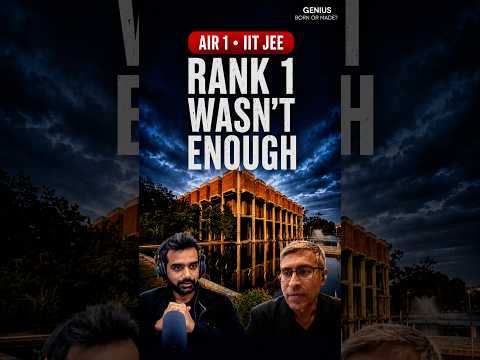
Vineet Buch topped India's toughest engineering exam as a teenager. In this conversation, he explains why exam success didn't fully prepare him for real life, how parents can nurture ambition without pressure, and what actually builds a meaningful career.
Vineet Buch topped India's toughest engineering exam as a teenager — a feat that taught him how to structure hard work and love the process, but, he argues, academics are poor preparation for the messy problems of real life. This episode is about what actually built him, and what school left out.
What this episode answers
Does ranking first in exams (like IIT JEE) predict success in life?
Not directly. Vineet Buch argues that academics are a poor preparation for real life: exams hand you well-structured problems, but in real life the hard part is finding the right question, not the answer. Real achievement, he says, comes not just from solitary problem-solving but from motivating a group of people toward a common goal — something exams never test.
“in real life, the hard part is not finding the answer, it is finding the right question. And academia does not train you for that.”
How do you stay motivated through years of hard exam prep?
Fall in love with the daily process instead of the outcome. Buch broke a two-year goal into a single checkable task each day and judged each day by whether he enjoyed the work and hit that day's goal. He treated preparation as a marathon, not a sprint — protecting sleep as non-negotiable — because if you are miserable the whole way, you won't perform under pressure when the one big day arrives.
“you can control your effort, but not the fruits of it.”
How should parents raise an ambitious, self-driven child without pressure?
Don't impose a specific ambition; show, by example, that setting and achieving your own goals is intrinsically satisfying. Buch's parents never told him to become a doctor or to come first — they treated him as a capable adult, supported him, and refused to cap his ambition. A broad expectation ("you can do anything, we'll support you") builds drive; a narrow one ("be a doctor") creates pressure.
“They did not try to impose their ambitions on me. But at the same time, they showed me that doing things, that achieving things, that setting goals for yourself and then achieving them, has an inherent satisfaction independent of the goal.”
Is genius born or made?
Both — but where you start matters far less than the process you build. Buch acknowledges some abilities are genuinely innate at the very top (a Beethoven, a Hilbert), but for almost any meaningful goal, the deciding factor is having a repeatable process to get from where you are to where you want to go — and the skills to structure hard preparation can be developed by anyone.
“it doesn't really particularly matter where one starts. What matters is having a process to get from there to where you ideally want to go.”
More from the conversation
How do you learn a new subject using AI like ChatGPT without becoming dependent on it?
Triangulate every answer instead of trusting one oracle. Even with no prior knowledge of a topic, you can sanity-check an AI's answer against physical constraints and other things you already know — if the numbers imply something absurd, the answer is probably wrong. The skill that matters is refusing to switch your mind off.
“we don't shut our minds off and we try and triangulate answers we are given by using other things we might know that are not directly related but may still apply.”
What did Vineet Buch's parents actually do differently?
They made learning feel self-directed rather than imposed. His mother brought home volumes of the Encyclopedia Britannica and let him browse with no goal at all, which taught him that knowledge is something you pursue for joy — and that figuring out how to pursue it is an art in itself.
“I just loved that experience of learning without a goal.”
How do you deal with a life-altering diagnosis like ankylosing spondylitis?
Accept that life is random, then act anyway. Diagnosed with ankylosing spondylitis and told he could never run again, Buch decided to assume he could function normally until proven otherwise, and to focus only on making his immediate present a little better. Giving up buys nothing; you can do your best and still fail, but it beats not trying.
“I will ask for forgiveness, not permission. And I will assume that I can function normally until otherwise proven.”
Should students get real-world or work exposure, not just academics?
Yes. Buch credits the IITs with teaching the basic engineering concepts well — what's missing, he says, is the application of them: he took a chip-design course without ever seeing a microprocessor, and points to the US system's industry–academia nexus as what India's top schools lack. The truest measure of what you build isn't a grade; it's whether someone actually uses it and pays for it.
“The truest sign of the value of what you are creating is somebody uses it. And more importantly, even pays for it. The grade is just a very poor approximation to that.”
How should India reform the IITs and engineering education?
Keep what works and add what's missing. Buch says the IITs succeed by selecting highly motivated people and teaching the basic engineering concepts well, but they lack the application layer — he took a chip-design course without ever seeing a microprocessor — and the tight industry–academia collaboration he saw in the US. His fix is to build a genuine two-way nexus between universities and industry, the way Stanford did.
“There is a nexus between industry and academia that happens in the US especially… In India that is sorely lacking.”
Key ideas from the conversation
Exams reward answers. Life rewards questions.
School hands you a well-structured problem. Real work and leadership require finding the question worth solving in the first place — a skill academia rarely teaches.
Motivation must become daily, not dramatic.
A two-year goal is sustained by ordinary, repeatable work you can enjoy and check off each day — not by occasional bursts of intensity aimed at one distant outcome.
High standards need psychological safety.
Parents can build fierce ambition without fear when they support the child, refuse to cap the goal, and treat them as a capable adult rather than imposing a specific dream.
You can't outrun randomness — so act anyway.
Life is closer to quantum than Newtonian: effort doesn't guarantee outcome. The response isn't to give up but to do your best today and stay awake to better paths when they appear.
Quotable from this episode
“In real life, the hard part is not finding the answer, it is finding the right question.”
— Vineet Buch, IIT JEE All India Rank 1, on the Genius Born or Made? podcast
“You can control your effort, but not the fruits of it.”
— Vineet Buch, IIT JEE All India Rank 1, on the Genius Born or Made? podcast
“If I'm only focused on the summit, I'm more than likely to die on the way up.”
— Vineet Buch, IIT JEE All India Rank 1, on the Genius Born or Made? podcast
“The truest sign of the value of what you are creating is somebody uses it. And more importantly, even pays for it.”
— Vineet Buch, IIT JEE All India Rank 1, on the Genius Born or Made? podcast
“Life is not Newtonian mechanics. Life is quantum.”
— Vineet Buch, IIT JEE All India Rank 1, on the Genius Born or Made? podcast
“If you treat somebody like a kid, then they will behave like a kid.”
— Vineet Buch, IIT JEE All India Rank 1, on the Genius Born or Made? podcast
Watch the best moments
Full transcript & chapters
Jump to a moment
- 01:24Is genius born or made?
- 05:47Enjoy the process, not the outcome
- 09:28A self-built study campaign in Bhopal
- 15:38How his parents built ambition without pressure
- 22:25Why exams don't prepare you for real life
- 30:37Learning for joy: the encyclopedia
- 33:00Learning in the age of AI
- 40:18Why a grade is a poor measure of value
- 51:22A diagnosis, and a philosophy for randomness
Genius Born or Made? — Episode 3 IIT JEE Rank 1: What Exams Teach — and What They Don't Guest: Vineet Buch · Host: Himanshu Gupta
This is a lightly corrected transcript of the conversation. Auto-transcription errors (names, proper nouns) have been fixed; the speakers' words have not been rewritten.
—
Himanshu Gupta: Vineet, welcome to the show.
Vineet Buch: It's a pleasure to be here.
Himanshu Gupta: For those of you who do not know Vineet Buch, he is an amazing investor. I think he has invested in — how many unicorns, Vineet, through your fund?
Vineet Buch: I think we are up to about 20 unicorns now — 20 companies valued at a billion dollars or more. And a couple that have already exited for over a billion dollars.
Himanshu Gupta: That's amazing. So 20 unicorns. You've been a former entrepreneur yourself.
Vineet Buch: I have — both first unsuccessfully and then successfully.
Himanshu Gupta: A lot of people might not know that you are also All India Rank 1 in one of the most — in fact, the toughest exam for engineering. I want to start with the question we ask all our guests. When you think about this phrase, "genius born or made," and you think about your life, what's your response? How much of your genius was born, and how much was acquired?
Vineet Buch: I think the term genius can be overused. I think there is an aspect of human abilities that is absolutely inbuilt, that you're born with. One does not become a Beethoven, one does not become a mathematician like David Hilbert without having amazing off the charts, six, seven, eight sigma capabilities. But if you define it as achieving a goal that one finds meaningful — we can all do a lot with the abilities we have been given at birth, and really both use those abilities and learn how those abilities can be used to get someplace meaningful, both for us as well as for the world at large. So I think it doesn't really particularly matter where one starts. What matters is having a process to get from there to where you ideally want to go.
Himanshu Gupta: So in your case — imagine a 12-year-old in India making a goal that they also want to be rank one in IIT JEE. What abilities would they have to be born with, versus what could be built over time?
Vineet Buch: A goal where you're talking about a specific exam — a period when you have to achieve very intensely in a very short time frame, a small number of examinations which take place for three hours each — that does require the ability to think very fast and to solve relatively well-structured problems, but solve them under pressure, and fast. Not everybody can do that as well. The good news is that the skills that it takes to structure a program to prepare for something hard, those skills anybody can develop and they're applicable to all walks of life. I have always felt that I set academic goals for myself. They all came internally from within me. Nobody pushed me. The most important thing that it taught me was how to organize myself, my thoughts, how to create structure to work towards something meaningful over long periods of time — and not just focus on the goal, but to truly be in love with and enjoy the process. As long as one develops the ability to love the journey, you will be happy in life.
Himanshu Gupta: You said you were born with being able to think fast under pressure, and that solving complex, structured problems is a skill that can be acquired. And then you said you have to enjoy the process. But we are all driven by outcomes — that sets up a reward in our brains, dopamine. How did you tune your brain into enjoying the process and not caring about the outcome as much?
Vineet Buch: Anybody who has studied philosophy will have heard something along the lines of: you can control your effort, but not the fruits of it. And the way I translate that into my life — I also compete in running, I run road races and I'm very athletic, so I like to train towards goals, whether they are intellectual or physical. To me, it is not about what happens when I take the exam or run a race three months from now. It is: I have a set amount of preparation I must do today. Do I enjoy that? Did I have fun going to the track and running intervals? Did I have fun studying some aspect of physics or computer science today? If I don't enjoy that, it is pretty pointless to try and trudge through it in the hope that six months, a year from now, something wonderful will happen. You can't really control that. You could fall sick the day you have your big test. But if you have been miserable all along the way, then you are not even going to perform under pressure at the time because everything is hanging on that one day. It's much better to say, you know, I'm just going to enjoy the process. I have broken down the end state into goals today. I'm climbing Everest, but right now I just have to get to base camp. Let me be happy getting to base camp today and let me not worry about getting to the next higher camp three days from today. Because if I'm only focused on the summit, I'm more than likely to die on the way up. I should really just enjoy each step up the mountain. People don't understand, until you get involved in trying to do something hard, how much your mind and your body change as you do it. As I get better and better, I realize the changes that are happening in me, and I am enjoying that improvement. Whether I ultimately reach the summit or not — look how much better I got, and how many micro goals I achieved on the way towards that summit.
Himanshu Gupta: Take it back to Vineet Buch at 15, preparing for IIT JEE. What would a typical day look like where, at the end of the day, you felt you'd enjoyed the process?
Vineet Buch: I was doing all of this when I was in Bhopal, around 1987, 88, 89. Bhopal was a much smaller city than the major metros in India. There was not much of a history of people from Bhopal doing well in the exam — unlike Delhi or Bombay, where there were entire schools dedicated to preparing people for this. So I had to first plan my campaign. I had to figure out what I had to study and get hold of the materials, because they weren't easily available in Bhopal. And then I had to mostly, self-guided, prepare a program of study for myself. That was the first big hurdle. Then every day, this is what I'd assigned myself: I'm going to study and review and learn today. I had programs mapped out for weeks and months until I felt I had done all the material. And then I had to review everything. So there was a cycle of understand, absorb, review. Every day there was a goal, and at the end of the day I could check off whether I had done what I needed to. There was that little bit of dopamine for that one day. It did not matter that the exam was a year and three months away — today I had this goal and I hit that goal. And I did not prepare for the exam with the goal of entering an IIT. My goal from day one was to be number one.
Himanshu Gupta: You wanted to be number one.
Vineet Buch: I wanted to be number one. In June 1987, when the results of that year came out — I had finished 10th grade — I saw all the announcements and the big pictures of the guy, Rajesh Gopakumar, who came first that year. And I was like, that looks like a good thing to do. I want to do that two years from now. Then I spent those two years preparing for that. It was absolutely a methodical approach toward the specific goal.
Himanshu Gupta: Would you keep working into the night until you achieved that day's goal? And what if you weren't able to — how would you recalibrate?
Vineet Buch: In the two years of preparation, there was only one day in which I had to study late to achieve the goal for the day. I was studying column six of the periodic table, the oxygen-sulfur elements, in organic chemistry. This was October of 1988. My uncle, my father's younger brother, who actually lived in our house, had a stroke and he died that day. Needless to say, this was disruptive on many levels, and there were tons of people going in and out of the house, paying respects. But there was a column of the periodic table that had to be reviewed that day. I was like, well, this has to get done. So that was the only time in my life I have studied late — I was up to 3 a.m. that night, but it had to get done. In general, I was a big believer that I have to safeguard my health. I cannot sacrifice my sleep, because this is a marathon, not something I have to do for a couple of days. This is a two-year effort. Sleep is not negotiable. That was the one day where I just had to do it.
Himanshu Gupta: You saw someone achieving rank one and said, "I want to be rank one too." That speaks of ambition and of belief in yourself. Where did that come from? Who was the biggest influence in your life?
Vineet Buch: I had a blissful family life. I was an only child and my parents both worked. They were both in the Government of India, both pretty high up. They were amazing people in that they did not try to impose their ambitions on me. But at the same time, they showed me that doing things, that achieving things, that setting goals for yourself and then achieving them, has an inherent satisfaction independent of the goal. It is very affirming. Most people never appreciate that just the mere fact of saying "I will do this," and then doing it, has a joy all of its own. You do not need the medal. You do not need the cash prize. You just need the belief in yourself that I can set goals and then I can achieve them. That sets up a virtuous cycle where you can set more and more goals and do more and more. And that cycle got set up very early in my life — not because my parents made me, but because they showed me that this was possible in their lives, and by allowing me the freedom to set my own goals.
Himanshu Gupta: How did they show you?
Vineet Buch: Take the example of the things my parents did professionally. They were in the government, and you can be in the government just phoning it in, collecting the same paycheck as somebody who really wants to do a lot. My father was responsible for the redevelopment of Bhopal city, building a lot of what is the capital of the Pradesh. I could see that he was doing it because he wanted to make change happen. He wanted to provide housing for people, to have buildings created where people could live and work. He could have just not done anything and been a faceless bureaucrat and got essentially the same paycheck. No — he derived immense intrinsic satisfaction. Of course it gave him a lot of adulation from people, but he was doing it because he wanted to make things happen.
Himanshu Gupta: Did he actively talk about that with you?
Vineet Buch: In our house, the dinner table conversation was about policy and government. My mother used to bring home her files from the office and I would sit with her and go through the files together. We were not watching TV — well, there was no TV then — we were discussing what they were doing with their day.
Himanshu Gupta: Is it the fact that they treated you like an adult, not as a kid, that played a part?
Vineet Buch: Yes, absolutely. They never thought of me as a child — that there are some things we won't discuss with you. They were treating me as though I was a fully sentient human being who could make up my own mind. And if you treat somebody like that, then they will behave like that. If you treat somebody like a kid, then they will behave like a kid. So I was very much a young adult at a very early age.
Himanshu Gupta: That's a great playbook for parents. I have a seven-month-old now, and I keep telling my wife that we have to treat our baby as an adult. How else would they treat you like an adult?
Vineet Buch: A lot of the expectations parents have — there are two ways you can have expectations from your kid. On the one hand, you can say "we really, really want you to be a doctor." Well, then the kid thinks, they want me to be a doctor, why the pressure? That's a very specific expectation in which you are ignoring whatever the person may intrinsically want. On the other hand, you can say, "hey, we know you can do whatever you want. We are here to support you. We know that there are no limits to what you can achieve." That is a much broader expectation where you support the person and you do not cap their ambition. You just let them be. You let the flower bloom as wide as it can bloom. And you tell the flower, there is no cap on how big you can grow. That's how they were with me. They were never like "you must come first" or "you must be an engineer." They saw in me that I had the drive and the ability to do whatever I wanted, and they never ever capped my dreams.
Himanshu Gupta: Is there something you wish you'd been more exposed to as a kid that would have changed the outcome of your life?
Vineet Buch: I have done well academically and professionally, but I do feel that the academics is a poor preparation for real life — because in academia, you may encounter tough problems, but they're very well structured. Whereas in real life, the hard part is not finding the answer, it is finding the right question. And academia does not train you for that — especially Indian academia, especially when I was in India. I would have benefited from seeing more of "real life" at an earlier age. Instead of having to consciously unlearn a lot of things and then relearn new things, I think I would have learned a more nuanced perspective on life and its complexity — how one deals with people, and how real achievement in life comes not just from solitary pursuit of an individual goal, but from harnessing the power of a group of people and motivating them towards a common goal, often taking a step back yourself and letting other people take the credit so that the overall organization can achieve a much larger goal than any one individual can. These are all things one has to learn by experience in real life. You cannot really learn this in school.
Himanshu Gupta: If you were mentoring a 10-year-old from Bhopal, what would you do to help them prepare for real life, not just academic life?
Vineet Buch: This is harder in a country like India. Ten is a little early — you're still at home all the time. Working as a teenager, which in India is just unheard of unless you have to do it to put food on the table — working at an earlier age really exposes you to the dynamics of people, how to manage and interact with people in a non-academic, professional environment. But also, even if you are just able to observe a workplace — which never really happens in India; you never go to your parents' workplace to see what's happening. I was lucky in that I could see them interacting with people professionally at home, but I wasn't hanging out with them in the office. Exposure to a workplace would be very helpful, because how the sausage actually gets made is never something you can learn just by reading a book. You've got to see it.
Himanshu Gupta: Let's go back to students preparing for the engineering exam. What was your favorite subject — math, physics, or chemistry?
Vineet Buch: If I had to rank them, I would say math, physics, and chemistry in that order. I actually loved math. There was a time when I considered going into pure math as a field. I got talked out of it by a math professor at IIT Kanpur.
Himanshu Gupta: When did you realize you loved math and were amazingly good at it? Were you 10x better than your classmates?
Vineet Buch: Yeah, I was. After seventh grade I pretty much had the highest marks in every test in every course for the rest of my high school career. Learning came easy to me, but I also actually liked it. I did not have the mathematical talent of a Ramanujan — for them, numbers sing in their head — but I really enjoyed the beauty of it. You know how some people take a car engine apart and put it back together, they love how the pieces fit? I am not handy — I don't even change the oil in my car — but how concepts fit together just really, I just loved it. This concept from this field and that concept from that field, and you put them together and it fits into this beautiful little puzzle. It was just so enjoyable for me. It was never "I just have to memorize this today so I can answer it tomorrow and then never look at it again." I appreciated the beauty of it. The learning itself gave me joy.
Himanshu Gupta: When did you first realize this was something you found joyful? Walk us through it.
Vineet Buch: A seminal memory for me: when I was in fourth and fifth grade, we were living in Delhi, and my mother would bring home volumes of the Encyclopedia Britannica from her office library. I would flip through those while she sat by me and did the files she'd brought from the office. I just loved that experience of learning without a goal. I'm reading the encyclopedia, reading about Napoleon here and calculus over there — just articles organized alphabetically, pursuing these veins of knowledge through the pages without having to have an objective. That's when I realized that I actually dig this stuff. I enjoy soaking in information and seeing the puzzle pieces fit together in my head. That's when school shifted from being a chore — "I've got to go to school because I've got to go to school" — to "this is just absorption of things I generally enjoy."
Himanshu Gupta: Do you think your mom bringing the encyclopedia home played a crucial part?
Vineet Buch: Yeah. It gave me the awareness that I like to learn stuff, and it freed me from feeling that learning is something that is imposed upon me by a teacher in school. It was like, no, this is something I like doing for my own sake. It is not something I have to do because somebody is telling me to.
Himanshu Gupta: And the encyclopedia was organized alphabetically — so it also taught you how to pursue knowledge?
Vineet Buch: Right. Remember, it's all organized in volumes that are alphabetical. You might encounter something in a volume from AA to CCD, and then the concept you want to refer to is in volume E to F. You have to say, can you get this volume tomorrow? So you have to organize the pursuit of this information, because it's not all in one volume. This is not Wikipedia — you can't just click a link and get where you need to go. So it actually taught me how to pursue knowledge. Figuring out how you need to learn what you want to learn is an art in itself.
Himanshu Gupta: That's profound. Do you still follow the same playbook today when learning a new concept?
Vineet Buch: We're blessed that we have Wikipedia. I browse Wikipedia for fun every day — it is one of the best experiences one can have. But we also now live in a world of AI, where you can ask Gemini or ChatGPT to tell you whatever you want — but you still have to apply a filter to understand if that information is valid enough for your purposes, and if the sources consulted are actually the right ones. I no longer have to manually dig up paper books, but I still have to understand if what the internet is giving us is actually good enough. That skill we will always need, because no one oracle is ever going to give us all the answers — to some extent because the questions are somewhat fuzzy too.
Himanshu Gupta: Why are questions fuzzy?
Vineet Buch: If you want to ask a simple question — what is the best way to cook a piece of halibut in the air fryer? — you have to realize there are different thicknesses of fish fillets, that fish from California aren't the same as fish from Alaska, and some people want it done more, some less. Just because the recipe tells you 425 degrees Fahrenheit for 13 minutes does not mean you blindly follow it. You have to apply judgment and prior knowledge and the awareness that there is not one ideal conceptual model of a fish fillet. Real-life fish vary. And you have to account for that variation in actually executing on your task.
Himanshu Gupta: For someone who doesn't have prior context in a subject, how do they apply that? And what specific method of learning do you use with these AI bots, especially given people say chatbots are making us stupid?
Vineet Buch: The part where we cannot abdicate our responsibility is trying to triangulate the answer by different means. Say you're trying to learn about something where you have no real prior knowledge — reverse-osmosis water filtration, about which I know nothing. You get an answer on how it works, then you ask how much energy it requires. You have to triangulate that answer. If it says this is going to require building a nuclear power plant to give enough water for a city of 5,000 people, well, that doesn't sound right — other people are doing it for less, so maybe something is wrong with this answer. You can use your awareness of physical constraints in the larger world. Just because you don't know anything about the specific topic doesn't mean you cannot use other knowledge you have about the world at large to see if the answer feels and sounds right. This is really the meta-knowledge about how learning happens and how you encounter and validate facts. We have the ability — we just have to make sure we don't shut our minds off and we try and triangulate answers we are given by using other things we might know that are not directly related but may still apply.
Himanshu Gupta: So it goes back to your puzzle method — connecting new pieces to ones you've already solved. First-principles thinking. Now, you made an important point: academic achievement doesn't necessarily translate into life achievement. Is there a story of when you realized that?
Vineet Buch: I went to undergrad in India, then to the US for grad school at Cornell. In India we did a lot of practical building — I did computer science undergrad and we wrote software for classes, but we never considered that there was a utility for the software beyond a class assignment. I came to Cornell, and one of the professors, Ken Berman, had a company doing distributed systems. One of my grad school classmates was interning for him — actually writing stuff that was used in real production software systems, in their case air traffic control systems. That was actually shocking. Until then I had not realized that this stuff is not just abstract squiggles on a page. I knew it at an abstract level, but concretely I had never made that connection. And more importantly — it doesn't matter what grade my classmate gets in class. His stuff is real, and the grades are manufactured. The truest sign of the value of what you are creating is somebody uses it. And more importantly, even pays for it. The grade is just a very poor approximation to that.
Himanshu Gupta: So what challenge did you face? Were you given that opportunity and realized you didn't have the practical knowledge?
Vineet Buch: My particular challenge at the time was that I was actually quite sick — with an autoimmune arthritic disease called ankylosing spondylitis, which causes inflammation and pain of the major joints. Literally sitting in a chair and writing software was excruciatingly painful for me. Everything hurt, but sitting most of all, and I was constantly fatigued and in pain, and there were no effective treatments back then. So I was like, writing software for a living is not going to cut it for me. I have to find something better. That's when I realized that it is not just the writing of software that matters, but also the figuring out of what that software should do, and how to build and motivate a team of people to build it. That is just as, and potentially more, valuable — and I can do that because it doesn't require me to just sit in a chair all day. So that's how I got into product management. I had no idea there was such a thing as product management when I was in grad school. I had to understand what the workforce was like, and then — okay, this is a job I can actually do.
Himanshu Gupta: Both of us are products of the IIT system — the temple of talent. If you were to reform the IIT undergraduate engineering system, what two or three things would you introduce or cut?
Vineet Buch: The IITs have been very instrumental in my life. They work for two reasons: they pick some of the most motivated people in a country of 1.4 billion — selecting for people who are driven and academically gifted — and they have a good system for teaching the basic concepts of the engineering sciences. What is missing is the application thereof. We did a course in chip design, and never even saw a microprocessor — literally did not see a microprocessor. We were looking at schematic diagrams of the 8086, something most people have never heard of. In retrospect it seems insane. There is just that connection between abstract knowledge and the application of it to actual real-world situations that is so missing. When I came to Cornell, there were people building actual robots in the lab, people trying to build robotic cars for the DARPA competition. There is a nexus between industry and academia that happens in the US especially — at places like Stanford it is unbelievable how much collaboration and two-way transfer of talent there is. In India that is sorely lacking. The reason Stanford did better than the East Coast universities in the early days of Silicon Valley is that Stanford was much more forward-looking in terms of tech — Fred Terman really was the guy who did it. You need that mind shift, the understanding that knowledge has to flow both ways: industry has resources academia can benefit from, and academia has horsepower industry can benefit from.
Himanshu Gupta: You were diagnosed with a disease with very limited treatment options, and you converted that crisis into an opportunity to move into product management. But that's not how most people behave — especially someone as ambitious as you. Walk us through your mindset back then.
Vineet Buch: I felt sick when I was still in India, in my final year at IIT. It took a few months to get a definitive diagnosis. The exact words the doctor said were: well, you have this disease, you can never run again, you have to be on this pill for the rest of your life, and that's it. There was no hope, and the pill was just an anti-inflammatory that didn't really do any good. He was basically like, you're screwed, your life is over, and there is no hope. I was like, well, I'm only 21 years old, it's a little early to give up just yet. I was all set to leave in a couple of months for grad school. It really appeared that there was a lot of ambiguity about my future. There is no point standing still, because there is no equilibrium here — by standing still, I'm just going to remain in pain and not make any progress. So I might as well assume that I can make progress, and if something hurts too much, then I guess I won't be able to do it. My motto is very much: I will ask for forgiveness, not permission. And I will assume that I can function normally until otherwise proven. Of course, many things hurt too much. There was a while in grad school at Cornell when I was on crutches. I cannot define myself by being a patient. I have to still try. I don't know if I can tie my shoelaces tomorrow morning, but I'll worry about that tomorrow morning. What can I do right now, right now, to make my present and my immediate future a little bit better? That's all I can focus on. I have no control, no agency over the long term. Giving up doesn't really buy me anything, because then I'm just sitting here moaning about how much pain I'm in. The disease also caused inflammation in the eyes from time to time, so there would be times when I could only see out of one eye, and that definitely made it harder. But if you have no option, you can either give up or you can soldier on. There was just nothing to be gained by giving up. It also taught me that I don't matter, I am insignificant — good things happen to bad people and vice versa, so there is no point asking "why me." One has to accept objective reality and try and make the best of what one can do today, knowing full well that it might completely fail. There's no guarantee that just because you try your best, you will succeed. Somebody worked really hard and survived 80 days lost at sea on a raft with no food and no water — and all the other people who died after 75 days, nobody hears about them, because they are dead. So yes, you can try your best and still fail. But what is the alternative? You might as well try. That was literally my entire governing philosophy.
Himanshu Gupta: Was that the first real setback for someone used to achieving their goals? How did that feel?
Vineet Buch: It was a massive wake-up call. My mindset in life had been: my life is about setting whatever goal I want, and if I just work hard enough, I will achieve it. And suddenly I realized that, you know what, life is not Newtonian mechanics, life is quantum. There is a lot of randomness in there, and you do not know. It's not the case that an object in motion in a straight line with enough velocity will just continue — there are random collisions from electrons here, there, and everywhere, and what path your particle takes in the cloud chamber, you do not know. You cannot insulate yourself from the randomness. Nobody can. So it is better to learn to accept it and deal with it as it happens than to be overly wed to one goal. And this applies both ways. Some people start companies with a certain objective, and along the way opportunities arise, and they say — forget what I'm doing right now, the other thing that just emerged, that's the way to go. Other people say, I am on this path, and it doesn't matter that there is a bigger pot of gold over there, I must pursue this path. Sometimes you're better off if you get nudged onto a different path. You just have to be awake enough to see it. So accept that I have goals and objectives, and the universe does not care what they are. Random things will happen, and I have to learn to adjust to them. I can do my best and still fail — but man, it feels better to have done my best and fail than not to have done my best and succeeded or not succeeded.
About the guest
Vineet Buch
IIT JEE All India Rank 1
Vineet Buch scored All India Rank 1 in the IIT JEE and studied computer science at IIT Kanpur, then earned a master's at Cornell. He co-founded Like.com (acquired by Google), led product for Google Shopping and Google Play, and is now a partner at Firebolt Ventures — a fund whose portfolio includes roughly 20 companies that went on to become unicorns.
Keep going — every episode, in full, with questions, answers & transcripts.